
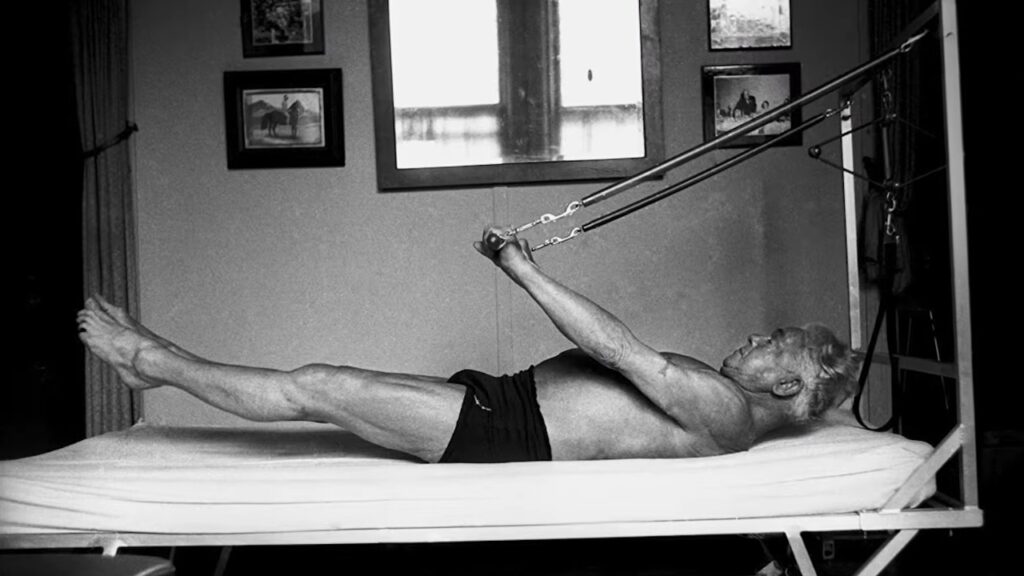
When I worked in a Reformer studio, the hospital bed story came up almost every week. A beginner would be lying on the carriage, legs shaking through footwork, and ask how anyone ever dreamed up a machine like this.
Somebody nearby always had the answer ready, usually involving a prisoner of war camp, a row of hospital beds and a handful of springs.
I told it myself more than once. No record proves Joseph Pilates rigged hospital beds with springs, and his own patent describes a machine that worked with a weight and a pulley. Camp records and that patent show what actually happened.
The Story Most Studios Tell
The version I heard most often goes roughly like this. During World War I, Joseph Pilates was held in Britain as a German national, worked as a hospital orderly, and fixed bed springs to the frames so patients who could not stand could still exercise against resistance. That contraption supposedly grew into the Reformer.
Details shift depending on who tells it, and several of the usual add-ons fall apart once you check them.
- The prisoner of war label. He was a civilian internee, held because of his nationality, not a captured soldier.
- The hospital orderly job. Researchers studying his camp have found no confirmed record of it.
- The bed springs. Some historians doubt the camp even had many spring beds.
- The finished machine. His first Reformer patent came years after the war, filed first in Germany and then in the United States.
What the Camp Records Confirm
The most detailed timeline I have found comes from the Knockaloe Centre on the Isle of Man, which researches the camp that held him. Its internee profile of Joseph Pilates uses his index card, camp newspapers and repatriation records.
| Date | What happened | Evidence |
| Early August 1914 | With a traveling circus in Blackpool, then registered as an enemy alien | Documented |
| 1914 to 1915 | About 12 months in a temporary camp in Lancaster | Documented |
| September 12, 1915 | Arrived at Knockaloe and placed in Camp 4, index number 14001 | Documented |
| January 1917 | Refereed a boxing match reported in the camp newspaper | Documented |
| March 22, 1919 | Repatriated to Germany | Documented |
| Unknown | Worked in a camp hospital | Not confirmed |
His index card even spelled his name “Pilatus” before someone corrected it. The records never show the part everyone remembers. Nothing places him on a hospital ward, and nothing mentions springs.
Why Historians Doubt the Bed Springs
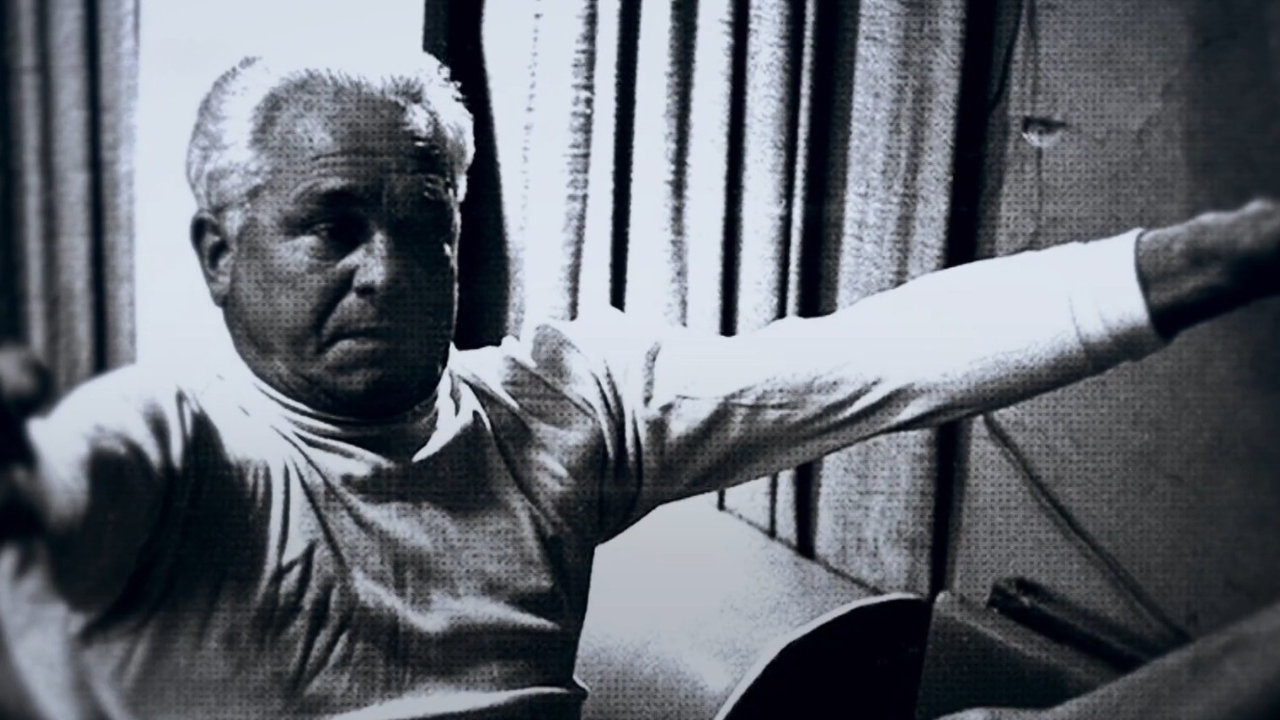
Missing paperwork is only half the problem. Biographers who studied his internment questioned the story because metal beds were rare at Knockaloe, and without spring beds, the famous springs would have had to come from somewhere else.
The Knockaloe Charitable Trust, the charity researching the camp, has stated that there is “no proof of his hospital involvement,” as reported by Popular Science.
Absence of proof cuts both ways, though. Jonathan Grubb, whose great-grandfather was also held at Knockaloe, wrote for Pilates Intel that nobody has proven the beds lacked springs either. He even tested the idea of building rehab equipment from bed springs and found that it works.
A museum photograph of a hospital orderly in Camp 2 looks strikingly like Pilates, but nobody has confirmed it is him. Whether he ever worked as an orderly remains open.
His 1927 Patent Describes Weights, Not Beds
View this post on Instagram
The patent surprised me most. Joseph Pilates filed his US application for a gymnastic apparatus on August 24, 1925, and it was granted on March 15, 1927. Google Patents lists a priority date of August 27, 1924, and the document gives his home as Hamburg, Germany.
The drawings show a sliding carriage with shoulder pieces, a head rest and a foot bar. Resistance comes from a weight hanging on a cord over a pulley, and springs or other elastic parts appear only as an alternative.
The words hospital, bed and invalid are nowhere in the text. He pitched it as gentle exercise for limited spaces such as living rooms.
Did You Know?
The same patent says the machine suits people with weakened foot arches or only one sound leg. So rehabilitation is in the original document, even if the hospital bed is not.
Where the Legend Probably Started
Most of the hospital story traces back to Pilates himself. He said he worked with invalids during the war and began devising machines for their recovery. His claims turn up in several places.
- A 1956 Dance Magazine profile by Doris Hering, describing him designing machines for disabled men.
- A 1962 Sports Illustrated interview with Robert Wernick, where he said his principles came to him during the war.
- A letter printed in his 1945 book, Return to Life Through Contrology, praising his wartime training.
He was also a confident self-promoter. A review in Inside Story notes that he claimed a birth year of 1880, about three years too early, and hinted at descent from Pontius Pilate, which researchers could not support.
Pontius Pilate was a Roman prefect whose name has become forever entwined with the crucifixion of Jesus Christ.
Despite being a central figure in a story that has been told for over two millennia, we know little about the man himself and the events that shaped his life after the crucifixion.
Early works by Josephus, Eusebius, and other early Christian historians provide a window into his later life, allowing us to try and answer the question: What happened to Pontius Pilate later in life?
Learn more: https://t.co/WIon50aUyq
— Fascinating (@fasc1nate) September 20, 2026
Camp researchers believe he built a miniature model while interned, but that awaits confirmation. I read his war stories as part memory, part marketing.
Why the Story Still Makes Sense on a Reformer
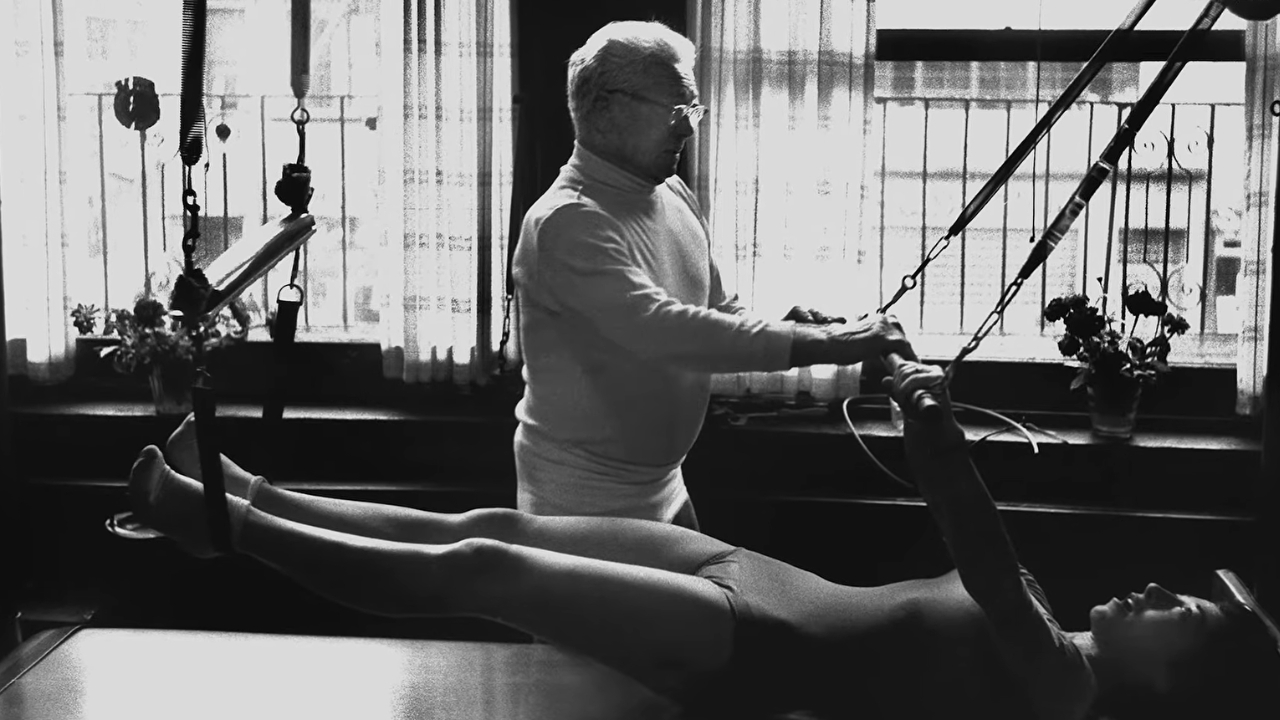
Funnily enough, the legend gets the mechanics right. When I worked in the studio, the hardest idea to get across was that springs do more than add load.
In footwork, heavier springs make the legs work harder. Many stability exercises flip that, because a lighter spring lets the carriage slide more freely, so the trunk and shoulders have to stop it from running away.
A spring can also carry part of your weight and help you through a range you could not manage alone. For a patient stuck in bed, that kind of support would have been the whole point.
I see the same thing whenever a client who thought the machine looked terrifying discovers that the springs are helping, not attacking.
If the carriage, springs and footbar still feel foreign, my beginner guide to Reformer Pilates walks through each part.
How I Tell the Story to New Clients Now
I still tell it, because a nervous beginner relaxes a little when they hear the machine started as something humble. I just tell it honestly now. Camp 4 is documented, the boxing referee job is documented, and the bed springs are a maybe.
The patent gives me a better punchline anyway. Joseph Pilates pitched his apparatus as something for a living room. Ninety-nine years after the patent was granted, the same idea fills boutique studios with rows of carriages, and each one takes up a lot of floor space. That space is a big reason one Reformer class can cost as much as dinner out.
If your instructor repeats the hospital bed version, ask whether they have seen the pulley drawing. It usually starts a better conversation than another set of footwork.
So Did the First Reformer Come From a Hospital Bed?
@annasarol The story of how a hospital bed created Pilates🔥 #pilatesworkout #pilatesinstructor #pilates ♬ luxurious x be your girl(jersey club) – Flaiir Beats
Based on the records available in October 2026, nobody can honestly answer yes. His internment is documented down to the camp, the date he arrived, and the number on his index card. The hospital job, the bed springs, and the miniature camp model are still unconfirmed.
What does survive is a patent filed from Hamburg that used a weight on a pulley, with springs only as an option.
Next time I hear the bed story beside a Reformer, I will enjoy it, then mention Camp 4 and that pulley.