
The first time someone asks me how much Pilates costs, my annoying instructor answer is usually, “Which kind?” A mat class at a gym, a small reformer class, and an hour alone with an instructor can all carry the Pilates name while landing in completely different price brackets.
In the US right now, a realistic 2026 starting range is about $15 to $35 for group mat, $25 to $60 for group reformer, and $100 to $175 for many private sessions.
I’ll show you what those numbers actually mean, because the cheapest option on a pricing page isn’t always the cheapest way to build a routine.
What Pilates costs right now in the US
I started doing what I suspect most people do when they want to know what Pilates really costs: opening studio websites and ending up with far too many tabs.
I compared public prices from studios in New York, Los Angeles, San Francisco, Boston, Austin, and Miami.
Some were noticeably more expensive than others, but after a while the numbers started settling into a pattern. A single reformer class was often somewhere around $40, while private sessions could easily climb past $100.
Pilates option
Typical price I found
Prices in the studio sample
Group mat class
About 18–35
Varies widely by studio
Group reformer drop-in
Around $40
25–50
10-class reformer pack
Around $357
210–450
8 classes per month
Around $220
180–296
Private session
Around $125
100–175
That does not mean your local studio will charge exactly $40 for reformer Pilates or $125 for a private session. These are the middle prices from the studios I compared, and there was plenty of variation around them.
A small studio in Manhattan and one in a lower-cost market are not working with the same rent, class sizes, or expenses. I would use these numbers as a reality check rather than a price list.
Mat Pilates is cheaper, but I would not call it the cheaper version of Pilates
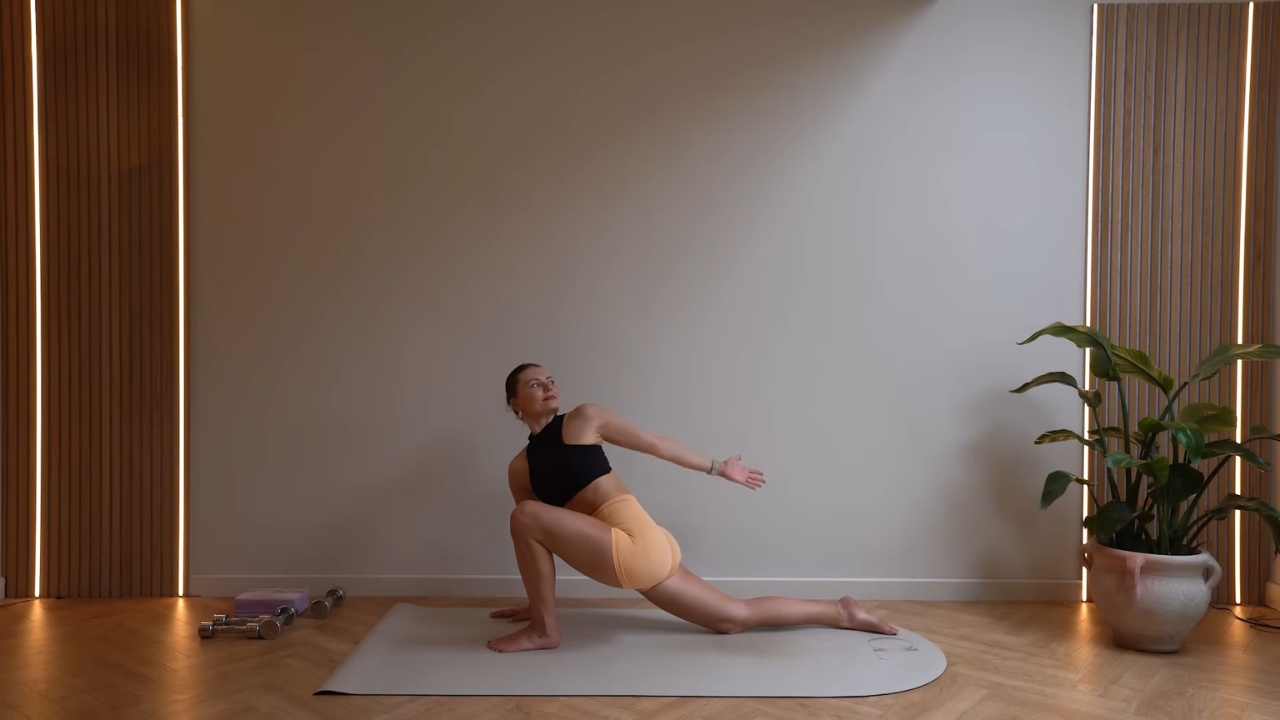
Because I came to Pilates after yoga, working on a mat already felt completely normal to me. I never saw it as the class you take until you can afford a reformer. And after teaching movement for long enough, I still think that is the wrong way to look at it.
Reformer studios now play a big role in the Pilates lifestyle online, yet a good Pilates routine can look very different off social media.
The price difference mostly comes down to what is happening in the room. A mat class can fit more people and needs very little equipment. A reformer class needs one machine for every person, which puts a very obvious limit on how many people can join.
Current US pricing puts many group classes around:
Class type
Typical 2026 price
What you are paying for
Group mat Pilates
15–35
Larger classes and little equipment
Group reformer Pilates
25–60
Smaller groups and use of a reformer
And please do not mistake cheaper for easy. I have had plenty of mat sessions where a movement looked almost laughably small and my muscles had a very different opinion about it thirty seconds later.
Mat Pilates has also expanded into newer formats, with hot mat Pilates now especially popular with younger clients.
Your ZIP code can change the price quite a bit
Once I started comparing studio prices around the country, this was one of the first things that jumped out at me. There really is no single US Pilates price.
Even among six major cities, the numbers moved around enough that I would be careful about calling any one figure “normal.”
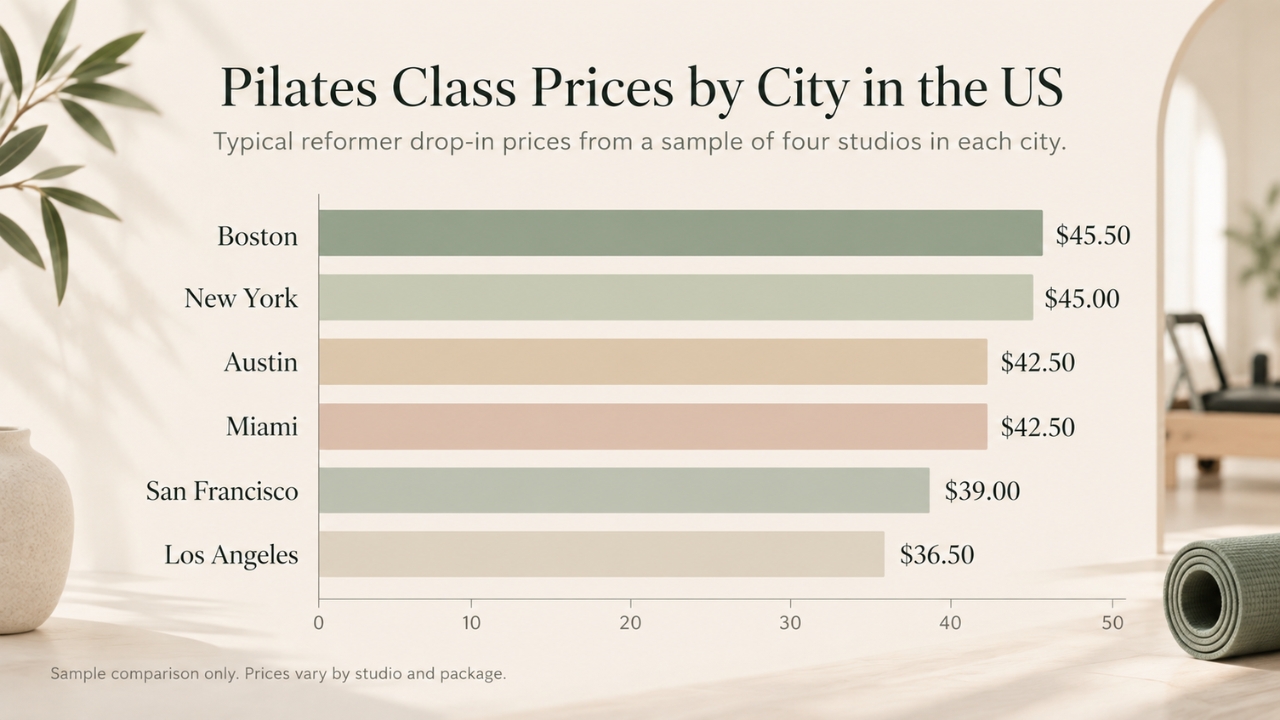
These numbers came from four studios in each city, so I would use them as a comparison, not a promise of what you will find around the corner. Even two studios in the same city can charge very different amounts.
If I were looking for a class near me, I would pull up three or four studios and compare their regular prices before making any judgment. Intro deals are lovely, but eventually you have to pay the normal rate. That is the number I care about.
Before buying a membership, be very honest about your week
Unlimited sounds wonderful. It gives me the same optimistic feeling as buying a very organized new planner in January. Then your actual schedule gets involved.
The studio prices I compared put eight classes per month around $220, which works out to $27.50 a class if you attend all eight. Go only four times, and you are effectively paying $55 each time.
That is why I would work backward from the number of classes I can realistically attend instead of starting with the membership that looks like the best deal.
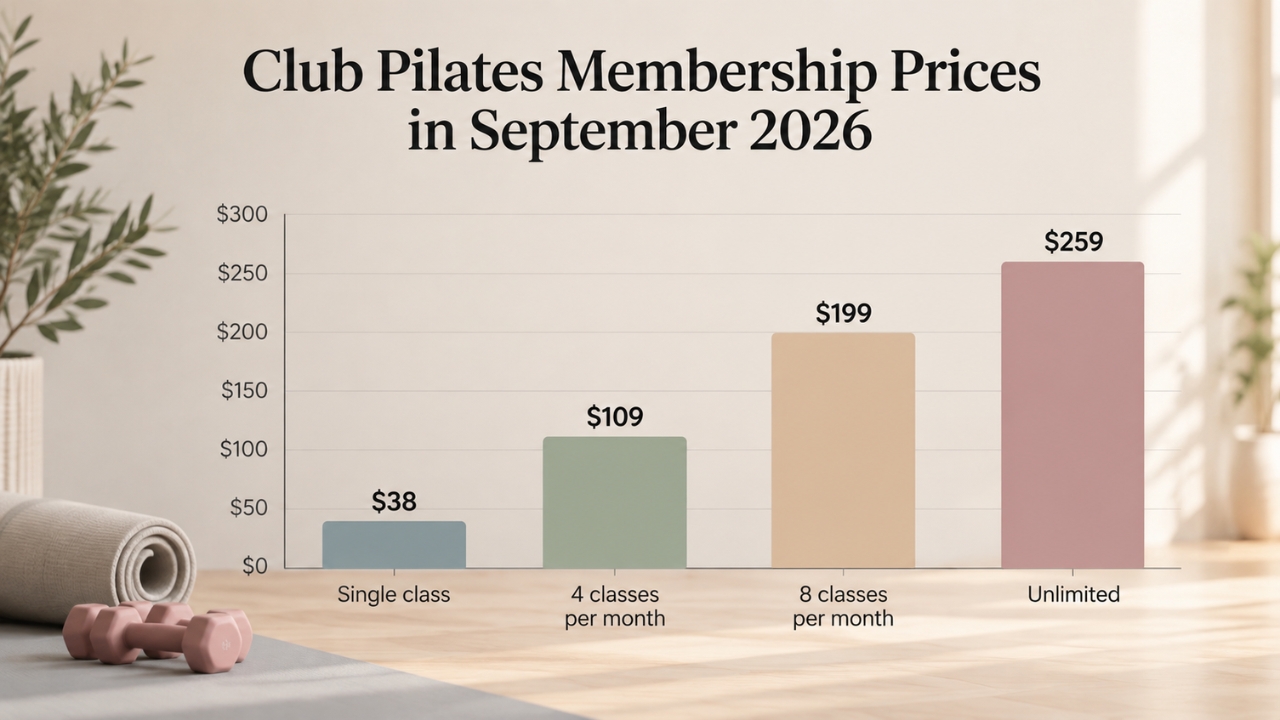
Those Club Pilates figures come from a September 2026 review of published prices at more than 1,200 locations, but individual franchises set their own rates. Your local studio may charge something different.
For me, the useful question is very simple: how many Tuesdays, Thursdays, or Saturday mornings are you genuinely going to protect for Pilates? Start there. The membership choice gets much easier after that.
There is a reason reformer classes cost more
A $45 or $50 reformer class can look expensive next to a $20 mat class, but the setup is completely different. Every person in a reformer class needs a machine, so a studio with ten reformers has ten spots.
Modern Reformers are expensive studio machines, but their early history is less clear. Even the famous claim about Joseph Pilates and his hospital-bed Reformer lacks firm documentary evidence.
Then there is the cost of the equipment, maintenance, instructors, insurance, and the space those machines take up. That is a big part of why reformer Pilates classes cost what they do.
Some studios have taken a different approach: Reformer classes without an instructor can cost as little as $5, although a video cannot correct your form.
I remember reading recently that 81 million Americans belonged to a gym, studio, or other fitness facility in 2025. What stuck with me even more was that Pilates was still growing alongside yoga and other mind-body classes.
ClassPass tells a similar story: Pilates was its most-booked workout for the third straight year in 2025, with reservations up 66%.
View this post on Instagram
So yes, reformer costs more. You are paying for a smaller class, specialized equipment, and a limited spot in the room.
Private Pilates is where the bill gets serious
Private sessions are where the price really jumps. In the studios I compared, most were between $100 and $175, with many sitting around $125. You are paying for the instructor’s full attention instead of sharing it with a whole class.
I can see the value if you are new to the reformer or want more help with your movement. But I would not assume private is always better.
For many people, one or two private sessions followed by group classes will be plenty. Semi-private sessions can be a cheaper middle ground, often around $40 to $75 per person.
If it were my money, this is how I would choose
I would ignore the biggest introductory offer on the screen for a minute and look for the normal price underneath it. Then I would open my calendar.
That sounds less exciting than comparing unlimited memberships, but it tells me much more. If I knew I could only attend once or twice a month, I would probably stick with drop-ins or a small class pack. If Tuesday and Thursday evenings were already realistic Pilates times for me, an eight-class monthly plan would make much more sense.
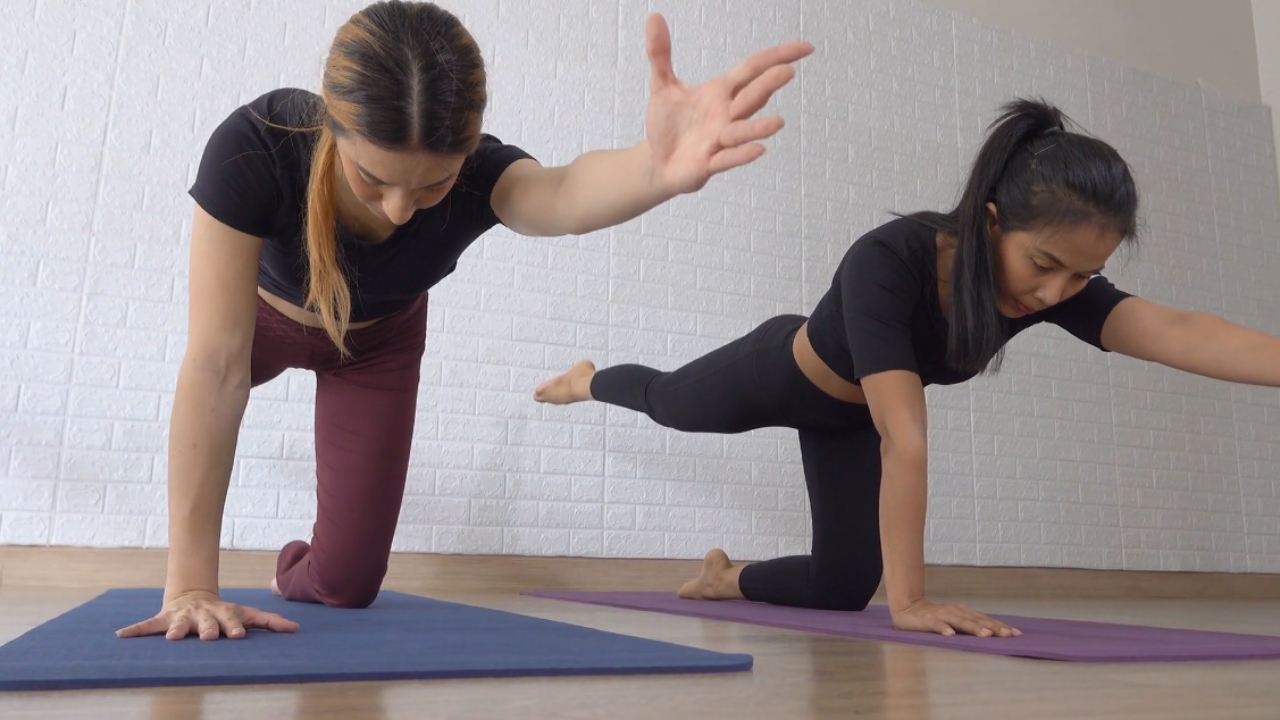
I would also give mat classes a fair chance instead of deciding that every Pilates session has to involve a reformer. Some of the movements that have challenged me most have required very little equipment and a suspiciously innocent-looking mat.
My rough decision would look like this:
- Occasional class: pay as you go.
- A few classes each month: look at a small pack.
- About twice a week: compare eight-class memberships.
- Three or more classes most weeks: then unlimited may start making sense.
The best deal is the one that gets used. I know that is considerably less exciting than finding a secret Pilates pricing hack, but unfortunately the calendar keeps winning this argument.